This is my new site dedicated to teaching and learning history. You can expect to see a lot of maps, graphics and plenty of text. My hope is that the essays and activities that I post here will be helpful to teachers and students and perhaps change the ways you think about learning history.
I hope that I have convinced you that history is more than just a series of facts, but even if I haven’t, we still need to consider where these facts come from. A smart-alec will say, “books,” but that still leaves us with the question of how that information got into the books in the first place. Most of the facts that we find in history books, especially textbooks, will come from a variety of sources, but these sources fall into different categories or types. The four basic types of information that you are likely to find in a history book are:
Historical information, which comes from texts
Archaeological information, which comes from the remains of things that people made, also called material culture
Anthropological information, which usually comes from examining existing groups of people and making analogies to the past
Scientific information, which comes from analyzing data that is collected using contemporary technology and techniques
One of the most important skills that you can develop as a student of history, is recognizing which types of facts you are looking at, and thinking about how your knowledge of these categories might change the way you understand what you are learning about the past.
Historical Information
Since this is a book about learning history, it’s probably best to start with historical information. Most historical information comes from texts, although that word can have a pretty broad meaning. For art historians, paintings, sculptures and other forms of visual art can be texts. Music and film can be texts, although you won’t find any examples of the latter from ancient or early modern history. But wait, you might be thinking, I’ve seen excellent films about the past, and not just those starring Alex Winter and Keanu Reeves.[1] There are many wonderful films about history, but most of them are not the sort of sources that historians would use as the basis of history, which brings us to a VERY important distinction in types of historical sources.
Most, but certainly not all, original historical writing is based on primary sources. These are texts written by people who lived at the time that the historian is writing about. So, a primary source from the American Revolution would have to have been written around 1776, and primary source about the Ottoman capture of Constantinople would come from around 1453. Movies, (or “films” if you are a bit more snooty about them), don’t come into the picture until the late 19th century, so they can only be considered primary sources for the time they were made.
For example, if we take the film 300 a 2007 movie about the battle of Thermopylae based on a comic book from 1998, and try to use it as a primary source about the actual battle, which took place in 480 BCE, we’ll be in a heap of trouble. For one thing, the movie is fiction based on another fictional account and has only limited relation to actual events. For it to be a primary source, there would need to have been movie cameras set up in Thermopylae in 480BCE filming the actual battle, and that would have required technologies that the ancient Greeks and Persians, for all their cleverness, did not possess.[2] If we want to use the film 300 as a primary source to learn something about 2007, for example why such a movie would resonate with American audiences after six years of war in Afghanistan and three years of war in Iraq, or about homoerotic imagery and Orientalism in the early 21st century, or even why American film audiences were comfortable with ancient Greeks being played by British actors using their British accents, then we might be on firmer ground. For a primary source on Thermopylae itself, though, we’re going to have to go back a little further, to one of the fathers of (Western) history, Herodotus.
Most of what we know about the battle of Thermopylae, and the Persian wars that it was a part of, comes from Herodotus’s book, The Histories, which was probably completed in 425 BCE, or thereabouts. Herodotus himself was born in Halicarnassus around 484 BCE, which tells us something important at the get-g0. Unless he was a very precocious 4-year old with remarkably permissive parents, we can be reasonably certain that Herodotus did not himself witness the events at Thermopylae, or anything else he writes about the Persian wars in his histories. In a number of places he makes it very clear that he is relying on the accounts of others, but there’s plenty in his book to suggest that Herodotus had a vivid imagination, and that calls into question how “factual” his history really is. If Herodotus wasn’t present at the events he describes, and we can’t really vouch for the reliability of the witnesses on which he bases his account, why do we consider The Histories a primary source? For one thing, it’s pretty much the only thing we have that is written about the Persian Wars that comes from a time remotely close to them. It’s the remotely close aspect of them that matters so much. Herodotus wasn’t there to see the things he describes, but it is at least possible that the people who reported those events to him were.
In more modern history writing, we would consider the quotations from witnesses to be the primary sources and the historian’s interpretation of them to be secondary sources, but with older texts, the entire source is usually considered primary. Returning to Herodotus, his Histories contains a great deal of reported dialogue and almost all of it was probably invented. The entire book is a primary source for the 5th century BCE, not just the questionable dialogue. With a more modern history, say a book on the Vietnam war written in the 1990s, the primary sources would be the quotations from soldiers who fought and civilians who experienced the war firsthand, and the historian’s interpretations of those quotes are a secondary source.
In a typical middle or high school history class you don’t see too many secondary sources. Most of what students get to work with are primary sources and textbooks, which might be called tertiary sources, since most textbooks are derived from the work of other historians[3]. The textbooks we know and love (or loathe as the case may be) tend to make up the bulk of a student’s experience with learning history, which is both good and bad. It’s good because well-written textbooks can provide a framework for understanding the broad strokes of what historians consider important. But textbooks can be bad if we think that they contain a complete and accurate record of what happened. They can be a good starting point, but they make a lousy endpoint. Secondary sources can be wonderful to read, and it’s a shame that we don’t use more of them in school, because if you go on to read history as an adult, you’ll likely be reading secondary sources.
As I hope has become clear so far, dates are rather important when we read history. Not only the dates of events that are being described, but the dates when the descriptions were produced. Often there are no accounts written during the time events happened, especially the further back we go, so how do we make statements about those events or phenomena. Sometimes we have to rely on analogy, but when we do, we must be cautious[4]. One example of this understanding by analogy occurs in one of the books I use to teach ancient history. In a section about pastoral nomadic warriors from the second and first millennium BCE, the authors provide a quote from a Chinese writer about the Xiongnu, nomadic warriors that menaced China in the first centuryCE. Not paying attention to the dates, it would be easy to assume that the description of the Xiongnu was a primary source for the earlier nomadic groups, but it’s not. When historians use sources this way they are making an analogy between a later group and an earlier one, saying in effect that the similarities between these two groups are greater than their differences. This type of argument by analogy is the essence of what happens when anthropology shows up in our history books.
Anthropological Information
It’s always useful to remember that for most of the time that humans have inhabited the planet (at least 90,000 of our 100,000 years, if we estimate conservatively) the only records that of their existence are the tools that they made that happened to survive, and their skeletons. No pictures, no writing, and certainly no written history. Until we invent time machines there is no way to know for certain exactly how early humans lived, so we must use our imaginations and make inferences about them. One way to do this would be to assume that human beings are unchanging in their basic patterns of thoughts and behaviors, so they are fundamentally not so different from you and me. But you and I can read books and we wear clothing made from synthetic fabrics and we eat processed food, sometimes that we haven’t even prepared for ourselves. And we eat sugar and coffee and all sorts of things that were unknown to our earliest ancestors. To imagine prehistoric humans as behaving just like modern ones is actually to deny their unique history.
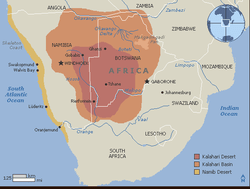
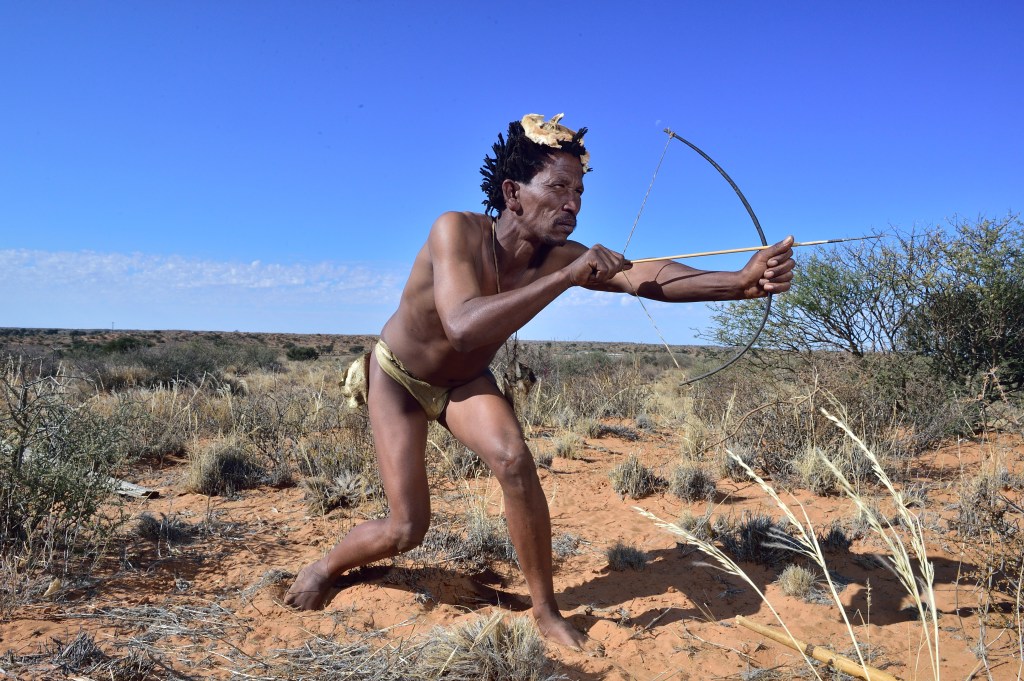
Instead historians can draw from the lessons of anthropology, looking at those foragers who still exist, or often at the descriptions of foragers recorded by anthropologists in the 19th and 20th centuries, and making an analogy between these later foragers and the earlier ones. Thus, if you want to understand what it was like for a forager in western Africa in 50,000 BCE, examine the lives of San foragers of south western Africa, or the descriptions of how they lived before many of them were forced to become farmers[5].
But there are a number of problems with this way of reconstructing the past. Most of the foraging people who have maintained that way of living have been pushed to the most marginal lands by people who live as agriculturalists or in industrial societies. It is likely that when foragers had more space to choose from, their patterns of foraging were very different. This is especially true when looking at food. To assume that foragers from 50,000 years ago lived off the same food supplies provided by the least hospitable environment such as the one where foragers are forced to live today would give us an inaccurate picture.
In addition, it does not seem plausible that current foragers have not been influenced in their ways of living by contact with other more numerous people. One of the constant features of world history is that interaction between peoples is a catalyst for change.[6] 100,000 years ago there were many fewer people (source), so it was much less likely that one group could force significant change on another. Now, even the most isolated people can still be influenced by outside groups, and it is reasonable to assume that they would be, and therefore the foraging lifestyle that can be observed today has also been subject to outside influence.
All of this is to say that our descriptions and understanding of how foragers lived is a matter of conjecture and inference. This doesn’t mean that we should throw up our hands and say that we can’t really KNOW anything about them, only that we need to be careful to remember that very little of what we can say about foragers should be taken as 100% certain. That’s something to remember about other people and places we learn about as well.
Before looking at archaeology, I should say a last (for the time being) word about anthropology. If you read enough history textbooks, especially the early sections about “pre-historic” people, you are likely to come across the word primitive, to describe foragers or early agriculturalists. You might even see the word primitive used to describe foragers or agriculturalists living in the world today, if they don’t have so-called modern technology like telecommunications or internal combustion engines or chemical fertilizers, to name a few key technologies that I would argue are hallmarks of 21st century life. Anytime you see the word “primitive” an alarm bell should go off. Few words are more judgmental than primitive, except perhaps for, “civilized” or “modern” or “advanced” or … well you get the idea. As with any description of a people who are not the same as you, it’s best to think of them as just that, not the same as you, since this will open you up to thinking about how they are not the same, why they are not the same, and what the differences between you and them say about BOTH you and them.
Archaeological Information
Archaeology is very closely connected to history, especially ancient history. Often the only information we have about complex societies from the distant past comes from the things that they left behind, especially those things that were built to last like, well, buildings. Except for inscribed walls and artifacts, understanding these objects, sometimes called material culture, requires that we make inferences about the people who created them. As we saw in the last post, we can be more confident in some of those inferences than others. To paraphrase one of the archaeology books I used long ago, it takes imagination to make the mute stones speak.
Archaeological evidence can be tricky. The first issue is that it is almost always incomplete. Although new technology like LIDAR can tell archaeologists about underground remains that haven’t yet been excavated, human beings have been building things on earth for a long time, so there’s a lot of places to look. A second problem is that we have an unfortunate tendency to build our settlements on top of old ones. Sometimes, as in the case of the ancient city of Troy, it means that there are multiple cities to uncover and the remains of one gets mixed in with the remains of others. Even worse, from the archaeological standpoint, is when a modern, still inhabited city gets build on top of an older one. Anyone who has visited Mexico City and seen the Templo Mayor right next to the cathedral and Palacio Nacional has experienced this.
Templo Mayor & Cathedral, Mexico City
Most of the inferences that we make come from the archaeological remains that we find, but we can also draw conclusions from the things we don’t discover. For example, the presence of a wall around a city suggests at least two things: one, that the city felt enough of a threat that they build a wall for protection, and, two, that the people who ran the city were able to mobilize enough resources, especially workers, to build the wall.[7] Both of those inferences seem pretty solid, perhaps solid enough to call them historical facts. It might even be that they are so obvious that historians wouldn’t mention them, but that would be a shame, because if a city were under constant threat of attack and was organized in such a way that its leaders could compel the amount of labor required to build a wall, those two facts would have been very important in structuring the lives of the people living in the city, and are definitely worth knowing and thinking about.
What about the absence of walls? It’s possible that a city lacking a wall was a city without enemies, but it would take a bit more evidence to reach that conclusion. If a thorough examination of a city’s remains revealed no walls an also no evidence of weapons, we might be on firmer ground in saying that external threats to that city were minimal, as has sometimes been said of the Indus Valley civilizations, where the cities were wall-less and few weapons have been found. As with almost all archaeological evidence, though we need to be careful with the conclusions that we draw. It’s possible that the people of the Indus Valley did have weapons, but that they were made of wood or other organic material that would have disappeared over the course of 3000 years.
Map of the Indus Valley
Let’s stay with the Indus Valley for another example of a problematic inference that we might draw from the absence of material remains. Approximately 1500 Indus Valley sites have been discovered, but in all those sites, archaeologists have not found many structures that can be confidently identified as religious buildings. Does the lack of temples mean that the people of the Indus Valley culture had no religion? Of course not. The absence of buildings that we might recognize as religious only means that their religion did not feature the sort of religious structures that we are familiar with, so rather than seeing this as a deficit, it’s better to see it as an opportunity to look for other types of evidence to figure out, if we can, what sort of religious ideas and practices they had.
This leads us to another aspect of archaeology that might encourage us to be a little more careful in drawing historical lessons. Often the biggest and most durable structures that a culture creates served the culture’s elite more than its general populace. Temples, for example, were built and maintained for priests or other religious leaders, and not for direct use by the common people. Palaces were the homes of political elites, and forts were used primarily by soldiers. Architectural remains tend to have an elite bias that we need to remember, so while they can be especially helpful in understanding political or religious structures and a society’s values, they may not be able to tell us as much about how common people lived as we would like.
Luckily, there is a rich archaeological source that we can use to learn more about how non-elite people lived in the distant past, or if you want to be pedantic, about how non-elite people died. These are graves, and although they can feature a similar elite bias to that of architecture, we can learn a great deal about a culture from how people disposed of their dead. One of the ways graves can help us most is by using them comparatively to learn about different levels of social status. Although it’s not 100% certain, it’s reasonably safe to say that people who were buried with more goods, or goods of higher value had a higher status than those with fewer or lower quality grave goods. The amount of information that historians take from grave goods can be truly remarkable, especially when it comes to ancient history, and scientific advances are telling us more every day.
Scientific Information
Of all the types of information that goes into writing history, probably the most exciting is information that comes from advances in science. It is also the information about which I know the least and am least comfortable discussing, so this section will likely be the least detailed, and possibly the least accurate. But if you read more recent history books, you may find a number of ideas that have come out of hard scientific research and are often expressed in graphs, tables and charts using statistics. So, if you want to be historically literate in the 21st century, you won’t be able to avoid science and math (like I did when I was studying in school).
Before launching into a discussion of the new ways that science helps us understand old times, it’s necessary to remember that when we read statistical information about the past, this data are modern constructions, not primary sources describing what happened by the people who saw it. Sometimes we have some contemporary confirmation, such as the records people in Europe kept of the freezing temperatures during the Little Ice Age. More often than not, though, newly gathered scientific data can give insights into phenomena that had far reaching effects, like past climate and environmental changes, such as deforestation. It is likely that these phenomena, for example, lead concentrations in the air that can be measured using samples from ice cores, or changes in temperature that can be “read” in tree rings, would not have been available, or perhaps even visible, to people living at the time.
Sometimes, it isn’t that science has provided us with new data, but that we can look at it in new ways using statistics and mathematical modeling. One of my favorite examples of this has to do with my favorite data source from the ancient world: graves. In his book Violence, Kinship and the Early Shang State, Roderick Campbell uses statistics to make a number of interesting points about social stratification during the age of the Shang (approximately 1600-1050 BCE). The mathematics are more complex than I want to get into here, but by counting the number of graves and the amount of grave goods found in each, he makes the point that over time, more and more people were buried with a larger number and a greater variety of grave goods, but that the wealthiest people would still be found with the most and most valuable goods. From this he concludes that the as the Shang era progressed, the region became wealthier, probably through trade, tribute and manufacturing, so that more people were able to acquire and be buried with more things. He further infers that lower classes were emulating the wealthier elites by copying their style of burial. He cements his arguments with a series of tables and charts that sure do seem to support his conclusions, but the truly fascinating thing about this chapter is the way he uses mathematics to create interpretations from archaeological finds.
Sticking with graves for one last example, new scientific techniques are beginning to be used to tell us things about human settlements that may seem obvious, but couldn’t be proved until very recently. This is because we now have the capability to analyze the most important thing found in any grave, the skeleton of the person interred. Thanks to the relatively new scientific field of paleogenetics and scientists’ ability to extract and analyze DNA from ancient skeletons, a 2019 study in the journal Science, argues two things that strengthen our understanding of social stratification among a group of ancient settled agriculturalists in Bronze Age Europe. The first thing their analysis reveals is that wealth was indeed kept within families, since the bodies in the graves with the greatest amount of funerary goods were genetically related to each other. They were also, surprise, males. The other fact that the scientists brought to light was that these early Eurasians practiced exogamy, they sent their young women away to be married and the men in this settlement brought in women from elsewhere to marry. We know this because the female skeletons that they have analyzed are not genetically related to any of the males, whereas the males were related to each other.
As with almost any of the conclusions that have become or will become historical “facts,” we need to take some of these new scientific findings with a grain of salt. After all, the scientists have only been able to get workable DNA samples from a small number of skeletons. It’s possible that more sophisticated analysis will poke a big hole in the conclusions about exogamy. This new way of looking at the past, using tools that were unavailable even thirty years ago is incredibly exciting for history, particularly ancient history, even as it makes learning about the past much more difficult.
Conclusion
The challenge for students and anyone else who wants to better understand the past is the one that this post invites you to seize. New technology has enabled us to find more information, and new perspectives on what matters in the past have led us to look for information that in the earlier eras wouldn’t have been considered important. As we gather all this new information, whether from scientific and statistical analysis, searching for new texts and material culture to study, or re-examining our assumptions in light of new or different theoretical perspectives, it is so much more important to try to examine not just what we know, but how we decide that we know it. Asking the question: “How do we know that?” about the past has always been crucial to learning history. Now, however, there are more answers to that question than there ever were before. So, as you continue in your endeavors to learn about the past, I wish you luck and perseverance, because you’re going to both.
[1] Bill and Ted’s Excellent Adventure (1989). Look it up, you philistines.
[2] Now, I suppose it is possible that the Greeks invented movie cameras, one of my film studies professors tried to make the point that Plato’s cave is the original movie theater, but it seems highly unlikely for many, many reasons, and even if they had invented movies, they would also have had to invent a storage system that would preserve celluloid film for 2500 years for us to see the actual footage. I’m not holding out hope that an archaeologist is going to find it.
[3] I don’t know what you would call this post. A quaternary source? A meta source? I’m open to suggestion.
[4] Like visiting a cantina in Mos Eisley – level cautious. Maybe even more.
[5] I chose the San as a representative example of foraging people because they are relatively well known and have been studied as a model of foragers. They are not the only group that could be used as a representative example.
[6]Quiz time: What kind of a fact am I presenting here?
[7] More on this in a later post on power and how (I think) it works.
You may have heard the expression that “history is just one damned fact after another,” hopefully as a criticism rather than an endorsement. Or you might subscribe to the idea, attributed to Henry Ford that “history is bunk,” although if you are reading this it’s unlikely that you agree. At the time this is being written, in 2019 the question of what constitute facts has a stark and somewhat distressing political relevance, certainly in the U.S. and perhaps around the world. Given that one of the frequent complaints that I hear as a teacher is that history is just a bunch of facts and dates (and sometimes people, usually white men) it is important, perhaps necessary, to explore what we mean by facts when we are studying and talking about history.
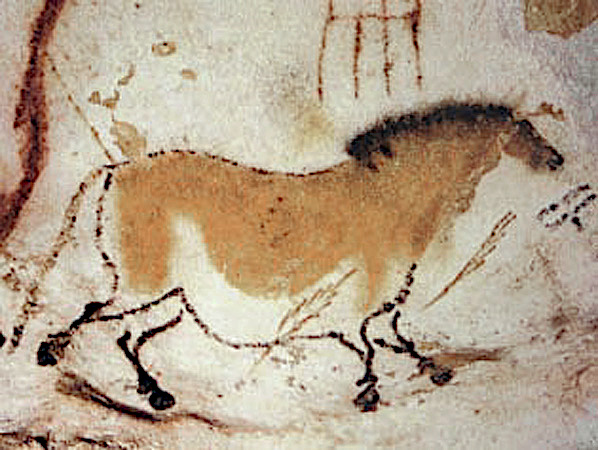
To begin considering what constitute historical facts, let’s go way back, to Paleolithic times and look at an image from the Lascaux caves in France. While we can’t be certain (more on this in a bit) it’s likely that images like this one are approximately 17,000 years old. They were created before agriculture and before writing, so we don’t have the words of the artist to tell us what the image means or why it was created. And yet, there are some statements we can make about it that we can be confident enough to call “facts.”
There is at least one thing we can assert about this image that is beyond question: the person who made it had access to pigments and knew how to apply those colors to the surface of a wall. That the image exists and that it consists of at least two colors laid out in a non-random pattern is enough to call its creation by a person who had access to and knew how to use pigments a “fact.” Based on the existence of the image itself we can assert two more historical facts. First, that long-ago human beings knew how to use pigments to create images and second, that they did so. Another way to say this, a way that might appear in a textbook is that, in Paleolithic times, some human beings created images on the walls of caves.
Because these facts are proved by the existence of the thing being described, I think of these as existential or first-order facts. These are the items we can say with nearly 100% certainty exist and were created at the time they originated. Unfortunately, many of these first order facts are, like the statement that the cave painting exists and was created by someone who knew how to create paintings in a cave, rather obvious and don’t tell us much that we really want to know.
So far so good, but is that all we can say with enough certainty to call our statement a fact? And even if we can agree that the above statement is true, so what? Don’t we want a little more than bare assertions of the existence of things? Is there anything else we can say about this image with enough confidence to call our statement a fact?
An important note about “important”
Teachers and students are both intimately familiar with the word important and its cousin, significant. I will be expounding on significance in a later chapter, but for now a word about important. It is a frustrating word because it says a great deal and nothing at the same time. When students (or teachers or textbooks) say that something is or was important, they are making a self-evident statement. Why would you bring it up if it wasn’t somehow meaningful, either in the moment or in your understanding of what happened in the past? Everything we say or write down has some importance, otherwise we wouldn’t say it. So when a student writes at the beginning of an essay, “Confucian ideas were very important in Chinese history,” they really aren’t saying much at all. What teachers, and historians, probably, want to know is why, this thing – Confucianism in Chinese history – was meaningful to people in the past and is meaningful to you now. The first question requires an act of imagination – it is difficult to really be certain why something or someone was meaningful to people living at the time it came about or lived – but the second question should be able to be answered. And answering that question, why is this thing we are learning about right now “important” is the essence of learning about history.
Getting back to the cave painting, there are other things we can say about it that, while not as concretely factual as statements of its existence, are so likely to be true that we can effectively say that they are facts. I call these inferential facts or virtual facts, and here is an example. One thing we can say with almost 100% certainty is that whoever made this image took some time and effort to do it. It’s in a cave, for one thing, and it would have taken some illumination for the artist to see what they were doing. Time spent making this image was not time spent finding and preparing food, so we can say that either the person who made it had enough food available, or that making this image was so important that they were willing to be hungry, at least for a little while. Either way, that someone took the time and energy to make this image shows that it was important to them because in general humans don’t do things unless they have some meaning, some importance although the exact nature of that importance is much more difficult to determine.
We have further inferential evidence that image-making was important to whoever created our cave horse. It’s in a cave. This suggests multiple inferential facts. First, the presence of this image is in a cave reinforces our suspicion that it was meaningful to the person who made it. Not only would it be difficult to make this painting in a dark cave, but putting it there probably means that the artist wanted it to be preserved. If so, they succeeded beyond their wildest dreams. We shouldn’t take this for granted. It’s probable that much of the evidence of their lives that humans have created over the past fifty to one hundred thousand years is gone, having been created to be used outdoors or without a thought for its permanence. But whoever made this knew it was going to last. Not only that, it was not meant to be seen all the time because it was made in a place that was, and still is, largely inaccessible. All of this together leads to a reasonably solid conclusion that image-making like this was very meaningful to the individual who made it and probably also to the community for which it was made.
So what sort of historical “facts” do we have based on this one piece of evidence, and does thinking about what constitutes a fact help us better understand the process of making and understanding “history”? Beyond the concrete and inferential facts laid out above, we can say for certain that there were people living at the time and in the place that the image was made, somewhere between 17,000 and 15,000 BCE in the southern part what is now known as France. It is highly likely that whoever made this was living near the caves that it was found semi-permanently because of the time and effort that it took to make the painting, although it is possible that the caves were an important space that nomadic or semi-nomadic people would return to over and over. To add detail to our picture, however, we need not only to rely on our historical imaginations, but to pull in information from other disciplines and modes of thought.
Modern scientific techniques can be particularly useful when trying to explain the remote past, especially when it comes to figuring out when something happened. By using radiocarbon dating techniques, we can determine, within a few hundred years, when an artifact was made, or when we find skeletal remains, when a person was alive. In the past 20 years, DNA sequencing has provided us with a great deal of information about the movement of early humans across the globe, although many of these conclusions are controversial and more importantly are based not only on analysis of genetic material but also on complex mathematical models.[1] Mathematics, especially probability, is incredibly useful in helping us create pictures or models of the past, at the most basic level because some events are more mathematically probable than others. A concrete example is that it is highly improbably to find any human being whose lifespan is greater than 115 years, so we can say with a high degree of confidence that when we find a skeleton, it belonged to someone who died before they reached the age of 115. Scientific analysis of the growth patterns in teeth and bones, can help us narrow this age range down, for example we can easily tell the difference between the skeletons of an infant and a fully-grown woman or man.
You have most likely noticed that I have been using terms like probably, likely and perhaps in this discussion, and that’s no accident. History books have a tendency to treat events in the past and the factors that caused them to happen as certainties. But I have suggested that the number of useful things that we can say about the past that we know with 100% certainty is pretty small. If we can only treat 100% certainties as facts, there isn’t all that much we can say about the past. Those “facts” I designated as inferential or second-order facts are really just descriptions that, when we examine them closely, have a high probability of being true. Are they absolutely 100% certain to have happened the way we describe them? No, but in order for us to move further in our understanding of the past we have to take some (quite a lot) of things that are very likely to have happened the way we say they happened and call those things “facts,” or “true.”
Before we get into hair splitting about what exact percentage of certainty we need to have in order to say that something in the past actually happened the way we say it happened, it’s time to look at a third type of statement that is often presented as an historic truth, but that I would say is an opinion masquerading as a fact. Often these fall under the rubric of “common knowledge” or things that “everybody knows,” but these are the facts you need to be most careful around.
Some of these facts-that-are-really-opinions are overtly political and thus easy to spot. The options here are almost limitless, but, since I am in the United States and most Americans take a fair amount of U.S. history while they are at school, I’ll start with an example from U.S. history. Here’s a statement you might find in a U.S. history textbook:
The United States is one of the world’s most durable democracies, having lasted since the ratification of the U.S. Constitution in 1789.[2]
That sounds pretty official and factual, doesn’t it. It even has a start date and although we might quibble with whether 246 years is a long time, when we consider that there wasn’t a Germany until 1870 or a China not ruled by a dynastic emperor until 1911, or that the Soviet Union only lasted from 1917 to 1989, the U.S. seems to have had a pretty good run. There are a number of ways that this supposedly factual statement is problematic however. The first is the question of duration, which goes against what I just said. Yes, in terms of modern nation-states the United States has a decent record of longevity, but that’s a reflection of our bias towards the present and towards what we know. Sticking with Europe, the French Bourbon family ruled from 1589 to 1792, with its most famous king, Louis XIV ruling for a whopping 72 years! 203 years is a long time for one family to rule over a country, but if you consider that the Bourbons were a subsidiary line of the Capet family, and the Capets ruled France[3] beginning in 987, then you can plausibly say that France had a Capetian king for 805 years (if I did my arithmetic correctly.)
But the question of duration isn’t even the biggest problem with considering our statement about the U.S. a fact. That comes from the question of what it means to call a polity[4] a democracy. Democracy comes from the Greek words kratia for “power” or “rule by” and demos, which is usually translated as “the people,” so it is reasonable to define it as rule by the people, as opposed to by a monarchy (rule by one person) or an aristocracy (rule by ‘the best’). I’m not sure what rule by the people looks like in practice, but in the U.S. we have a representative democracy, which suggests that “the people” chose representatives who rule. Now it is certainly the case that in the U.S. there have, since 1789, been a group of people who have voted to choose representatives, and in most cases the person receiving the most votes went on to be the representative of those who voted for him (or sometimes her, but mostly him). So in the strictest sense American representative democracy can be considered government by the people.
It is also true however, that for the first 130 years or so in the United States, in most states, about half of the population – the half that fall into the category of “women” – were usually not permitted to vote, which means that, by definition, only half of the “people” participated in the process of choosing the leaders. When we further consider that until 1965 a significant percentage[5] of people of African descent were in many places legally barred from voting, as were many people with Asian ancestry, and people who had emigrated from other places, it mathematically certain that far less than 50% of “the people” were responsible for choosing representatives, and this is without even considering that well into the 19th century in order to be able to vote men had to possess a certain amount of property.
Does this mean that the U.S. should not be considered a democracy, at least not before the passage of the Voting Rights Act in 1965? Some would say that it is categorically not a democracy, but my argument is rather that whether we call a polity democratic or not should depend on the level of political participation that exists there. As a rule of thumb, the greater the degree of participation (or put another way, the more people who are allowed to participate, whether or not they actually do) the more democratic the polity is. By this measure the U.S. is more democratic now than it was in 1789, or 1860, or 1900, or any time before 1965, but that doesn’t mean it is a democracy.
Even a relatively anodyne statement about the United States being a democracy turns out to be much more that a simple fact. I’m sure that for many people, although perhaps not many readers of this blog, that statement about American democracy is true enough to be considered an historical fact, but I would suggest that it shouldn’t be, or at least that we need to be more cognizant when we declare that it is. This is just one example of an issue that I’ll be returning to over the course of these posts – how do readers and students decide which interpretations to treat as so likely to be true that we can comfortably call them facts. It’s a huge challenge and one that can make learning history very frustrating, but it can also add a necessary degree of personal agency and commitment to the process of learning because it means that you as a learner can take ownership over what is “history.” This is not to say that you will always be correct in your assertions about the past – I’m certainly not – but I do hope that if you approach the history that you read and see critically, perhaps skeptically, but definitely with an eye towards distinguishing between first, second and third-order “facts,” you will find the process of learning history more engaging, enjoyable, and perhaps even liberating.
[1] I have a lot more to say about this in a later post.
[2] This is NOT actually something I found in a U.S. History textbook. I promise. No copyright violations here.
[3] I know, I know it’s a big stretch to say that the Capets, Valois and Bourbons ruled over a thing that we now consider “France,” but you’ll certainly find Capets, Valois and Boubons referred to as French Kings, which is really the point I am making – questions of what a territorially integral polity that we now call a nation-state or a country is are really difficult to pin down, which is why referring to them or the phenomena accompanying them as facts is rather tricky.
[4] JARGON ALERT! “polity” is a term I use A LOT as short-hand for a territory organized under a political regime. It’s really useful and definitely a term teachers and students should become familiar with.
[5] At the time of writing, it’s about 12%, but that number has varied over time.
Here is an activity that you can use to practice elaborating on your historical knowledge. I would love to see some examples of the diagrams you come up with.
Before we launch into what we might learn in history, I’d like to spend a bit of time discussing how we go about learning history. A lot has been written on historical thinking, or thinking like a historian, but most of us are not going to be historians and still need to develop a framework for understanding historical information and putting it in context. I’m going to try to show what I think happens when we learn history. What follows is based on a little bit of information processing theory (as I understand it), a fair amount of experience, and a bit of intuition, so bear with me.
Even though some people claim to love history, and the popularity of history-based television and movies, as well as the steady stream of mass-market history books suggests that this is true, I doubt that most of us have given much thought to what we are actually doing when we learn history. Although I have no proof of how the brain actually works when we learn, I suspect that when we learn new historical information, the process is one of schema building and elaboration.
A schema is like a framework of ideas or knowledge about a topic. Some schemas can be really simple, such as our framework for understanding that when the temperature drops, the days get shorter and the leaves fall off deciduous trees, we’re experiencing autumn. Under this schema, “autumn” means lower temperatures and shorter days than what we felt in the summer and the trees go from green to red, yellow, brown and eventually leafless. For many of us, that’s enough to know about autumn, but if learn more about it, what seems to happen is a process of elaborating upon that basic schema by adding new information in relation to the existing information, and possibly discarding information that now seems less probably true. To stick with autumn, we might add to our schema the information that it runs from the autumnal equinox to the winter solstice, and that these dates are usually around September 21st and December 21st. Further elaborations would include the role that the earth’s rotation and revolution play in our experience of the season, and that another word for “autumn” is “fall.” The key thing to remember here is that for the phenomenon of autumn, we each have a schema that represents our understanding of what “autumn” is.
The same process of building and elaborating upon a schema happens when we learn history. Since I don’t know how memory works in the brain, I’m going to try to make sense of this through an illustration, starting with a piece of historical information that I hope most of readers “know,” that in 1492 CE, Christopher Columbus set sail from Spain and discovered America.[1]
The diagram above represents a simple schema for historical knowledge of Columbus. Most readers probably remember the rhyme: “In Fourteen Hundred Ninety-two, Columbus sailed the ocean blue,” so the date “1492” and the act of Columbus sailing across the (Atlantic) ocean are placed as a single, central idea. On the left are subsidiary details that we might or might not remember, such as the name of the three ships he led on his first voyage and that Ferdinand and Isabella of Spain were the sponsors of his mission. I might have included other even less important details like the fact that Columbus was and Italian from Genoa, or even incorrect information, such as the false notion that most Europeans believed that the world was flat and only Columbus was brave, or foolish enough to assert it was a sphere.
On the right side of the diagram I have included information about where Columbus sailed and the results of his encounters. Hopefully most readers will have noticed that at least two of these details are factually incorrect. Columbus had nothing to do with the large empires in North and South America, here referred to as the Aztecs and Incas, although these people were eventually defeated militarily by Spanish military explorers, called conquistadors after the fact. Columbus did land in the Caribbean and establish “settlements,” a term that deliberately underplays the violence and destruction involved in colonizing the region.
Below the main idea are two major consequences of Columbus’s “discovery” that I expect everyone knows. That they are results of the “discovery” is indicated by the arrows pointing to them. Although the precise number of deaths of native peoples in the Americas is highly controversial, it is certainly in the millions and some estimates suggest that 90% of the native population perished as a result of contact with Europeans. I have designated the consequence, “Europeans settle in the Americas” as a blockbuster event or phenomenon by picturing it as an explosion to set it apart as information that is common knowledge, even if we don’t necessarily consider it a direct result of Columbus’s actions.
Before moving on to how we might elaborate on this schema through learning some history, I’d like you to ask yourself if this schema is familiar to you. Are there things in it you didn’t know or didn’t associate with Columbus? If there are other things that are missing, take a minute to write them down or, even better, print out the diagram and write directly on it. When you finish marking up the diagram, consider this question: How did I learn this information? If you can answer that question, you have a better understanding of your own historical thinking than I have of mine. I generated that diagram completely from memory (including the mistakes) and for the life of me I can’t tell you where, when or how I learned it. This to me is a crucial aspect of learning history that can make it easier but usually makes it much harder. Most of us have versions of historical events and phenomena that are deeply wired into our memories. Often these take the form of narratives which cause their own problems that I’ll deal with in another post. The main point is that learning history often involves a process of unlearning things that are stuck in our memories and we don’t even know how they got there.
To consider the role that unlearning plays in elaborating our schemas, look at this second diagram, which could represent our how our understanding of Columbus and the encounter between natives and Europeans changes after having some history instruction.
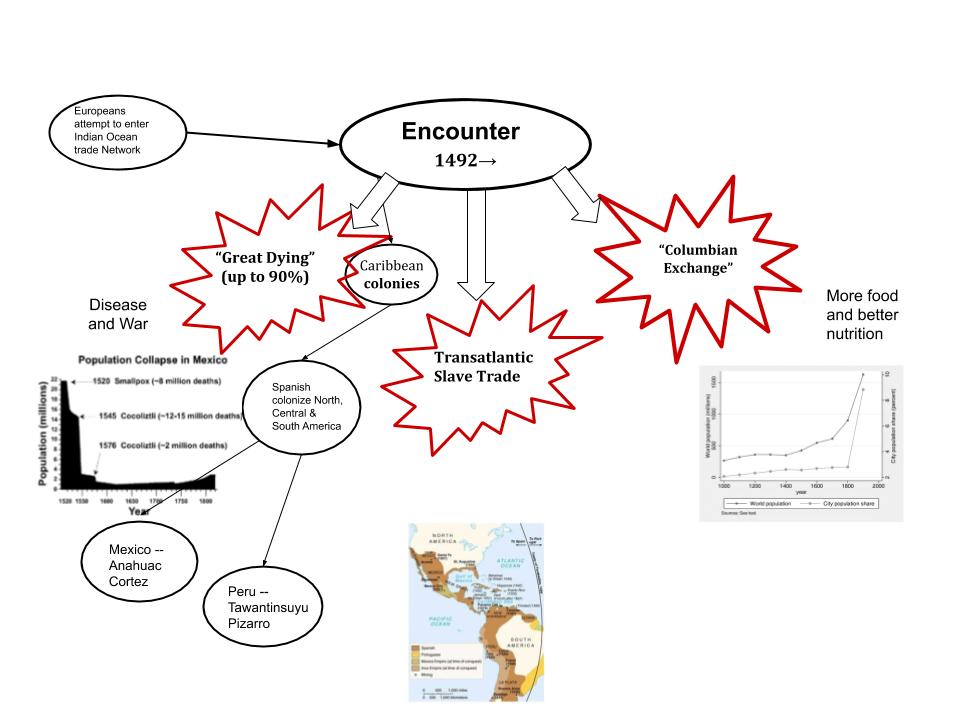
Columbus is still central here, but we’ve replaced his “discovery” with a more equitable term, “encounter,” providing a greater degree of agency for the natives, who have done as much discovering of Europeans as being discovered by them. Ferdinand and Isabella also remain, but now they have been given more context. Rather than simply hiring the adventurous Columbus, they now have a reason to do so. Ferdinand and Isabella wanted a piece of the action that was the lucrative trade that existed in the Indian Ocean.
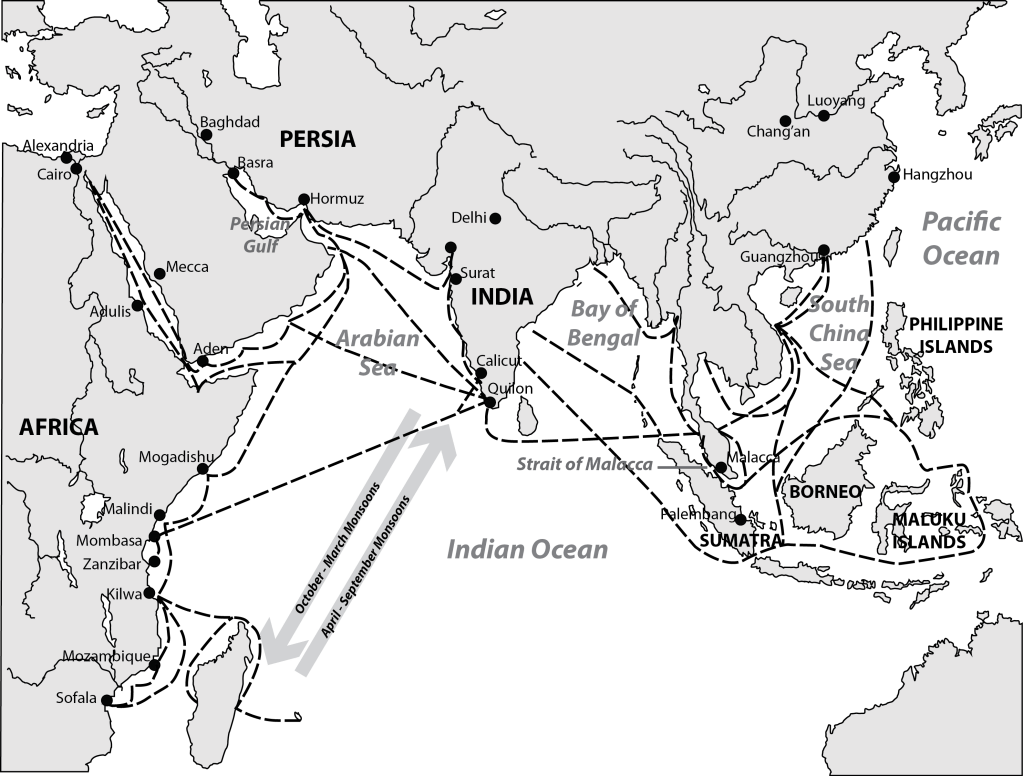
By the end of the 15th century, Europeans, mainly the Portuguese who were the first to sail around the southern tip of Africa, had finally been able to enter the vast and lucrative Indian Ocean Trade Network. For centuries, primarily-Muslim merchants had dominated the trade in this region that stretched from the eastern coast of Africa to China with India as its central fulcrum. Crucial to this trade were the spices produced in the islands to the south of mainland South East Asia, known as the East Indies. This trade would later fall into the hands of the Dutch, but at the turn of the 16th century the Portuguese were in charge, and to such an extent that the Spanish crown took the risk of sending Columbus westward in search of a route to the Indies that didn’t involve sailing all the way around Africa. It was the wealth of these “spice islands” that Columbus was hoping to find when he set sail, and his prior knowledge of them likely explains his initial confused confidence that the Caribbean Islands – the West Indies – were the East Indies that he was looking for.[2]
Columbus realized relatively quickly that he had not found the East Indies, but rather a new set of islands in the western hemisphere. He made multiple journeys to these islands, eventually enslaving native people and sending them back to Spain and convincing the monarchs to make him governor of one of the colonies that was established. These colonies never produced the revenues that the Spanish crown hoped for, and Columbus himself was a pretty poor manager. His voyages only truly paid off after 1519, when Cortez set sail from the colony of Cuba and through ruthlessness, brutality and more than a bit of luck, was able to topple the Anahuac empire that had been established in the environs of Tenochtitlan.[3] In 1532, Spanish troops under Pizarro managed to conquer the divided empire of Tawantinsuyu[4] in Peru and within thirty years the Spanish colony there was producing vast amounts of silver that Charles V and his successors used to finance a series of wars that did little to enhance Spain’s position in European politics, but did a lot to bankrupt the Spanish crown.
Mexico and Peru, which are pictured in the map to the left of the diagram, did have gold and silver which enriched the Spanish, but its agricultural production was probably more important in the long run. The Americas were the source of two foodstuffs that would revolutionize diets in Europe, Africa and Asia: potatoes and corn. It’s difficult to pick which of the two matters more. Corn is used to feed both animals and humans, so it probably gets the edge, but given how potatoes feature in cuisine from Germany to Italy to India, and the fact that they can in a pinch provide enough nutrition to sustain humans for quite some time, it’s a close call. Because it is such good animal feed, growing corn led to an increase in the production of beef and pork, and meat-eating became relatively common for a much larger cross-section of people, especially in Europe. The combination of meat, corn and potatoes greatly increased the number of lower-cost calories available to everyone regardless of class, and improved nutrition led to increased life-span and ultimately to population growth, especially in Europe, but also in India and Africa.[5],[6]
There’s a horrific flip side to population growth in Europe, though, and that is captured by the other major result on the diagram, the Great Dying. The death of native Americans appeared in our initial schema for Columbus, so the change of name and emphasis represent a revision of our understanding, a slightly different type of elaboration than the additions and subtractions we have been discussing to this point. The Great Dying is the term that many world historians now use to describe the devastating losses suffered by native Americans, mostly from diseases like smallpox to which they lacked immunity, but also from war and the brutal conditions that they were forced to endure on Spanish plantations and in mines. It is quite difficult to determine with confidence the numbers of people that died, but it is surely in the tens of millions, and the death rate for natives was anywhere between 25 and 90%.
But the horror doesn’t stop there. European colonizers didn’t move to the Americas en masse. The initial number of colonizers was small, and they needed people to work on the farms and in the mines that helped to make the colonies economically valuable. Initially they attempted to enslave native peoples and they had some success with this, but that success was limited for a variety of reasons, chiefly because so many of the native people were dying. To find another source of forced labor, the Europeans looked to Africa, and thus began one of the most terrible and horrific phenomena in world history, the transatlantic slave trade.
To try to discuss the transatlantic here would do it too great a disservice, and it will be coming up in future posts (and activities)[7]. At this point it’s enough to say that this was one of, if not the greatest tragedies in world history, with profound repercussions that echo down to this day. The key point to take away here is that it was a direct consequence of the encounter between Native Americans and Europeans and that without the transport of millions of Africans to the Caribbean, South, and North America, the world would be a completely different place.
By this point, our view of the encounter has shifted completely. Columbus no longer seems so important at all. The story is now one of colonization, destruction and, for the Europeans, the beginning of a path to population growth, increasing wealth, and, eventually, political domination over large areas of the globe. The most important results of the encounter are the deaths of millions of Native Americans and the destruction of their cultures by Europeans who colonize their land, the Columbian Exchange, and the Transatlantic Slave Trade. This updated schema is represented by the diagram below.
I’m sure you can see how different this newly elaborated understanding of the encounter is. Columbus is now out of the picture, as are Ferdinand and Isabella. We have some visual representations of the cost in lives in the Americas and the growth in world population that resulted from the new foodstuffs being imported into Europe and beyond. The destruction of the Anahuac and Tawantinsuyu states are still there as examples of European colonization. I decided not to elaborate on the transatlantic slave trade because that topic is so big and important that to add details to this thought diagram would overwhelm the original point. It’s as if you started talking about the rules of your favorite sport (for me that would probably be basketball) and tried to illustrate it with a discussion of the greatest team of all time. Both topics deserve attention and discussion and to try include one within the framework of the other will tend to diminish it because we can only attend to so many details without our understanding becoming overcrowded and confused.
This seems to be a good place to stop this particular discussion before it becomes unwieldy. My hope is that this essay provides a model of thinking about how we learn history that takes into account both what we and our students already know as a foundation to build upon. To add one more metaphor, learning history is like building a house. You start with a central plan and add rooms as your needs grow[8]. Sometimes you have to renovate the old rooms, maybe knocking down walls to make it easier to navigate, or adding a new nursery, or enlarging the doorways to make it easier for people with disabilities to feel welcome. As the metaphor suggests, learning history is a process of constructing, revising and re-constructing understanding, and sort of like creating a home, it’s never really finished.
[1] Now some readers will protest that Columbus didn’t discover America because it was already there and had its own rich history. I fully agree, and I will get to that, so bear with me. Trust the process.
[2] In the initial version of the story that you probably learned, Columbus may have thought that he had reached China, but it is unlikely that he would have made this mistake. Europeans had known about China for centuries before Columbus made his voyages, with the writings of merchants and adventurers like Marco Polo having been in circulation since the days of the Yuan Dynasty. It’s never been clear to me why in the Columbus story he’s disappointed not to find gold since the major source of European gold would have been West Africa, and he most certainly knew that he had not landed there.
[3] I’m using the more modern term for the empire that you will still see called the Aztecs or sometimes the Triple Alliance. This is another example of how new information leads us to update our schema.
[5] It probably led to population growth in Asia as well, especially as sweet potatoes entered the Chinese diet as a staple for the poor, but China’s population had been growing for centuries as a result of the adoption of a variety of rice that could yield two full crops per year, effectively doubling the amount of calories available from rice. There will be a lot more to say on this topic in a future post.
[6] And this doesn’t even begin to touch on the changes in cuisine brought about by new-world crops like tomatoes and sugar. Can you imagine Italian food without tomatoes? Well, up until the 16th century you would have to. And although sugar was not a new-world crop, without the colonization of Brazil and the Caribbean and the labor of enslaved people, Europe would never have developed such a sweet tooth.
[7] Really, I don’t want to minimize the scale of this monstrous tragedy, nor do I want to perpetuate inaccuracies about the slave trade here. In fact, the transatlantic slave trade is one of those areas of history that is ripe for the type of elaboration that I’m advocating for here.
[8] Apologies for the very first-world and American-centrism of this example. It’s been a long couple of weeks.
Learning history in and out of school has never been easier, or more difficult. If the process of learning history is mostly about amassing a personal database of “facts” about the past, history teachers are in a lot of trouble. If you don’t believe me, pick up your smartphone and ask: “When did Alexander the Great die?” or “Who was the first emperor of the Han Dynasty?” The answers you get are basically correct, and probably more thorough than what you would expect from a student in a typical history class.
Not only can students and teachers outsource their memory of historical information to pocket-sized supercomputers, the amount of historical information is increasing by leaps and bounds. (I would say it increases exponentially, but I can’t say for sure that this is mathematically the case, and I wouldn’t want to irritate my more mathematically-inclined friends.) Part of the reason for this is that there is just more of the past than there used to be. To use myself as an example, there are more than thirty years’ worth of events, people, data, ideas — all the stuff that we study in history class – that have happened since I finished studying the subject in high school. But the more important reason that we have more history now than ever before is that professional historians – as well as amateur historians, journalists, and especially experts in other disciplines – are looking at the past in new and exciting ways and uncovering information that people didn’t look for before.
There are hundreds of examples of newly-discovered history, but two should be sufficient to illustrate. First, consider the history of climate. The Earth’s climate has existed as long as the Earth has, much longer than humanity has, and over that time it has changed, often drastically. You might have learned in school about how the end of the last Ice Age ushered in the first agricultural innovations and settlements, but did you learn about subsequent major climactic changes? And even if you did, learn about them, you probably didn’t study them in particularly great detail or consider how those of us living in the 21st century could know so much about conditions so long ago. But now, because of new scientific techniques we can know much more about temperatures and rainfall in the distant past. And, because currently climate change is such a pressing concern, historians and other scholars have chosen to look at that data to try to construct a narrative of the Earth’s climate over time. Science has added an entire dimension to the study of the past that we now need to consider.
Traditional historical methods (i.e. relying primarily on texts) have also increased the amount of information that can and should be studied. For example, when you were in school, what did you learn about LGBTQ history? Probably not a lot. Does this mean that there were no LGBTQ individuals in the past? Obviously it doesn’t mean that, but what it does mean is that, for the most part, historians weren’t looking for evidence of LGBTQ people, or when they found LGBQT narratives, they either didn’t recognize them, or didn’t think they were important enough to include in the histories they wanted to tell, or deliberately omitted them because of prejudice against LGBTQ communities and individuals. But now, hopefully, your history courses are recognizing that stories and other information by and about LGBTQ communities, as well as indigenous communities and other numerical minorities and otherwise marginalized groups, need to be included in order to provide a fuller picture of the past.
Given the fact (and I’ll have a lot more to say about “facts” in a later post) that there is simply more history to teach and learn, what is EPIC history trying to accomplish? One thing I’m not going to attempt is to add more historical information to what already exists; that’s the job of real historians and better writers than I. And as much as I appreciate the necessary addition of unacknowledged or deliberately obscured narratives, there are others better equipped to add to the corpus of what we should know. EPIC history, I hope, will provide students and teachers with a new set of tools for thinking about how to learn about history. It’s a framework, perhaps a methodology, maybe a strategy for helping us better make sense of the past so that we can understand the present.
EPIC is an acronym that I use to categorize different approaches to learning history. It stands for Economics, Politics, Ideology/Culture. The C also stands for Contextualization, which, for me is the key skill to understanding the past. So, if it helps you can think of the system as EPIC2 or even EPI/C2 , which looks cooler but is harder to say (EPI slash C-squared?) and definitely doesn’t work as a URL.
I chose EPIC as the mnemonic and the structuring element for learning history because most of the questions that students are required to answer in history classes can be categorized as related to either economics, politics or ideology and culture. Being able to categorize questions and the information required to answer them is one of the key skills needed to really understand the past as well as how to be a better student. A good percentage of the difficulty that students have in studying history involves not understanding what they are being asked, in particular what type of question is in front of them.
Most questions that teachers ask in history class are probably still about politics and government, particularly about rulers and what they did or did not do. A classic example might be something like: How did the reforms instated by Peter the Great (or Ashoka or Darius I or Kleisthenes or Han Wudi or, well, you get the picture) change the Russian state? Even if you recognize that this is a question about politics, you still have to know a great deal to answer it. You need to know that a reform is a change, usually intended to be a positive one. You have to understand that change means movement from one set of conditions at time 1 (t1) to a second set of conditions at time 2 (t2). Most important, though, and probably the aspect of the question that students understand least is to know what “the state” is. Understanding the “P” in EPIC should make it easier to recognize what type of question you are facing, and how to answer it.
Ideology and Culture encompass a lot of the parts of history that are often least taught, especially in more modern history courses. Ideology includes the religions, ethical systems and philosophies that people live by, what might be thought of as “Belief Systems,” or BS. I choose this abbreviation on purpose, not because I don’t think they are important, but because discussions of belief systems often involve the broadest generalizations that we find in history classes simply because it is impossible to know what any one person truly believes, much less the reasons why they hold these beliefs or how a belief influences a person’s behavior. And if it is almost impossible to determine an individual’s beliefs it is even more difficult to determine a belief system for an entire community. Yet history teachers ask students to do it all the time.
Consider this question, one that I have asked in hundreds of classes over the years: Why did Buddhism spread throughout India and beyond after the 6th century BCE? Buddhism is a religion/belief system that claims millions of adherents worldwide in many, many different incarnations. It is one of the few religions that can truly be considered universal; anyone can become a Buddhist. But that doesn’t mean it’s monolithic. Ask ten Buddhists what a Buddhist believes and you will get at least ten answers, depending upon where and who you are asking the question to. And even if you can get satisfactory answers, there is almost no way that these can encompass the entire set of ideas and beliefs of a “Buddhists.” Because Buddhism – and any other belief system – is an ideology held by individuals, it is impossible to know exactly, or even with anything approximating precision, what Buddhists in general believe. To answer the question of why people believe in Buddhist or any other ideas is doubly impossible. Well, it might not be impossible, but it is not actually all that important to understanding what happened in the past. For most students, and, frankly most people, it is enough to know what Buddhism is (broadly speaking), when and where it began as a religion, and how and when it spread to other places in the world.
Yet history teachers try to explain the roots of ideologies all the time. To take another example, if you have ever taken an American history class you were asked something about why the colonists turned against Britain and sought independence. If you can answer this question, your answer probably has something to do with “unfair taxes,” but if you stop to think about it, even if the British did place taxes on the colonists (they did) is it likely that every colonist felt that the taxes were unfair? And even if every colonist felt that the taxes were unfair, what is the probability that every (or even a significant majority) of colonists felt that the taxes were so egregious as to justify separation from Britain? (you can explore this more fully in the elaboration activity that I will post shortly).
The point is, that when it comes to understanding ideology, it’s very difficult to even say what people believe without making broad generalizations. It is even more difficult to say why people hold to particular beliefs, so when we do this we are forced into even more generalizations. This is not to say that all generalizations are bad, although some clearly are. If we are going to say anything about the past, some generalizations will be necessary, as I will discuss more fully in another post. We need to be careful when we use them, however, and always be mindful that no general statement about beliefs or culture will apply 100% to all members of the culture we are examining.
I have lumped culture in with ideology because often in history classes the two are intertwined. When we say that a society is patriarchal, for example, we are talking about both a set of beliefs about the roles of men and women, and the ways those beliefs are expressed, often through literature, or art and sometimes through architecture, as in cases where women were sequestered in special precincts of houses or palaces. A great example of ideology being expressed directly through art comes from ancient Rome, which had temples dedicated to important ideas like faith, security and courage. Especially when looking at ancient societies, cultural artifacts are one of the only ways that we can learn about ideology, so it is useful to think of I and C as closely interrelated.
If you have read this far you have noticed that even though EPIC starts with E, I haven’t yet discussed economics. This is because I find economics to be the mode of analysis that ties all of the others together, the one that includes most of humanity, unlike politics which tends to have been the domain of men, and the one that is most often glossed over and misunderstood. Also, because economics is an ideology as well as a method for understanding the past, it can be very difficult for students and teachers to get their heads around.
What history classes mean by economics is a topic that will be dealt with in later chapters, but very briefly, it involves what a society produces and how it is distributed. I like to think of it as complex system of inputs and outputs that, if I were better at mathematics, I would describe with interconnected functions. The most basic economic relationship is between natural resources and food production. You can’t produce food without land (or water in the case of fish), and the amount of food that you produce will depend largely on how much land you have and its qualities as well as the climate where you live. How things get produced leads to more complicated economic questions: how much labor is required? Who provides the labor? What role does technology play in production, and we could go on.
Once goods (and food counts as a good) are produced, then the community must decide how the goods are going to be distributed. Is everyone going to have an equal share, or will a particular subset of the group have more than others? What are the rules for dividing things up? If there is a surplus, will it be traded for other goods that are not so easy to produce, or will it be saved up? And, perhaps the most important question of all: who decides?
This question of who decides leads us back to the cardinal point of EPIC history, that all of the elements are so intertwined that it can be difficult for students to disentangle them enough to formulate the kinds of questions that they can answer. Dividing historical information into EPIC categories is a first step in studying history; you can’t answer questions if you don’t know the kind of questions that are being asked. The next step, and this is the one that is truly crucial, is understanding that the categories are related and being able to describe the relationships. One more example should be helpful in demonstrating this complexity, which may or may not be all that helpful in itself.
Here is a question that history teachers should be asking and that their students should be able to answer:
How were Arab Muslims able to conquer and control such a vast territory in the 7th and 8th centuries CE?
Notice first that the question assumes that you know where the Arab conquests were and that the 7th and 8th centuries were between 600-800 CE. After that it becomes much trickier. The words conquer and control suggest that this is a question about Politics, so that should be the initial focus of your analysis. Conquer implies military force, which usually falls under the category of politics[1], and control suggests some form of structure or institutions of rule. So a good first pass at this question will mention something about the strengths of Arab armies, and the systems that they imposed over the peoples and territories that they conquered. Although it’s not strictly necessary, it’s probably a good idea to know something about the governments of the people who fell to the Arabs, mainly the Sassanid and Byzantine empires, and how their emperors ruled over their people provinces.
So far, so good. But conquest and control over territory require more than rulers and systems of extending rule, they require resources. Armies need to be fed, roads and buildings need to be built, and government officials need to be paid and in order to do any of these things, taxes need to be collected. All of this requires some sense of what the territory and the people in it can produce, especially how much they can produce beyond their daily needs, which in turn requires that we know something about the geography and climate of the territory and the population living there. Perhaps the most important rule of political history is that the state needs tax revenues to survive, so you can’t understand the state without understanding how it collects taxes. Our government question has become an economics question, because we cannot really understand how a government functions unless we understand what underpins its economy.
What about ideology and culture? Surely we can avoid those topics in answering our straightforward political/economic question about the first Muslim empire? Except that control implies not only government structures and institutions and the people who staff them, it also requires that the conquered obey the conquerors, at least in some degree. Obedience can come from force, which in terms of ideology might be framed as “might makes right.” Or perhaps there is a religious component to conquest, with credit for victory belonging to the god or gods of the conquerors. Maybe the conquerors’ set of ideas are just attractive, and people choose to adhere to them, discarding previous ideologies because they sense that the new rulers will provide a better life. Although we can’t say with 100% certainty that Islam was an attractive alternative to former Sassanids and Byzantines, if it were completely abhorrent to them it is unlikely that the religion would have taken such firm root there. The economics concept of revealed preference can be helpful here: one of the surest ways to know if someone prefers A to B is that she chooses A rather than B. For at least some (probably most) people living under the various Islamic empires that began in the 700s, Islam was preferred to alternative religions.
The interrelationship between Economics, Politics, Ideology and Culture is incredibly complex, which is one reason why history classes will often separate them into different dimensions of study. This separation is a simplification, but such simplifications, like generalizations are necessary to building a greater and more complex understanding of the past. They are also necessary to answering the types of questions that students are asked, the types of questions that build our understanding and, for better or worse, demonstrate this understanding to whoever is asking the questions.
This was supposed to be a brief introduction to the conceptual framework that EPIC History is trying to establish. My hope is that EPIC will provide a strong and comfortable foundation for anyone who studies history in school and beyond, and that using the thinking tools provided will enable you to better understand the world, both past and present.
[1] Michael Mann, whose ideas have informed my own, has his own model of historical sociology that separates out military as its own category. His acronym is IEMP standing for Ideology, Economics, Military and Politics. Obviously, he’s way smarter about this than I am, but I can’t see a good reason for separating military and political history, and EPIC is a much better acronym.





 EPIC past